RefCam at the World Cup: How a Referee Training Tool Became Football's Most Spectacular New Perspective
-
Arni -
June 16, 2026 at 1:31 PM -
1,253 Views -
0 Comments

First the Rule, Then the Camera
Before a camera could even go on a referee, the rulebook had to change first. At the IFAB's 140th Annual General Meeting in February 2026 in Wales, Law 5 (The Referee) was amended: referee cameras, whether chest- or head-mounted, are now permitted as a competition option, with the competition organizer supplying the cameras and controlling how the footage is used. Only this rule change made a World Cup deployment possible.
The technology isn't entirely new at FIFA tournaments, though. It was already tested at the 2025 Club World Cup, and of all people, the top refereeing official became a fan. Pierluigi Collina, chairman of the FIFA Referees Committee and famously not a man given to hasty enthusiasm, said afterward that the head-mounted cameras had gone "beyond our expectations." His take on the effect: you feel like you're right in the middle of the action, experiencing the speed and the pressure the referee is under.
The German Roots: A Training Tool from the Bergisches Land
Now for the part that interests us most. The RefCam technology comes from Riedel Communications in Wuppertal, the company many of us know as intercom and signal transport specialists, from Bolero to MediorNet to the Artist system. RefCam was developed through a joint venture called In-YS (In Your Shoes), together with two DFB referees, Patrick Kessel and Nicolas Winter, the latter also co-founder and managing director of In-YS.
Kessel, who spoke at SVG Europe's Football Summit in March, told the origin story: it began roughly seven years ago as a training tool for referees, letting them review matches from their own perspective to improve positioning and decision-making. His analogy makes the point well: a striker who misses a penalty can take a hundred more in training. A referee, by contrast, could until then only watch themselves from outside cameras, never from the perspective they actually make decisions from during the match. Winter's motivation even carries a professional undertone: the camera shows the unfiltered reality and the true speed of these decisions, which could help counter the shortage of young people entering refereeing.
Let's take a look at the technology itself, since it has come a long way. The camera doesn't simply sit on the head; it's fixed centrally at the ear using a custom-molded ear impression, aligned with the wearer's line of sight, which ensures stability and comfort. Total weight has been optimized to around 14 grams, barely noticeable. The image isn't transmitted via a conventional radio link into the stadium, but over Riedel's own Easy5G, a private 5G network that delivers HD video with low latency and integrates with Bolero intercom, MediorNet, and the RUN headsets. For data protection reasons, the microphone can be muted or switched off entirely, a detail that's anything but trivial in professional football, given how sensitive referee conversations can be.
Important for understanding the World Cup variant: Riedel had already built electronic image stabilization (EIS) into the system, keeping the picture steady and drawing viewers into the scene. The fact that Riedel additionally acquired the Austrian stabilizer specialist APEX Stabilizations in August 2024 shows just how seriously the company takes the issue of steady footage. This is exactly where the World Cup-level upgrade builds on, more on that shortly.
The system found its way into the public eye gradually, via the Bundesliga: its first deployment came in a match between Eintracht Frankfurt and VfL Wolfsburg, worn by referee Daniel Schlager, initially only for recording, with the footage airing in the 30-minute DFL format "Referees Mic'd Up." RefCam is now used live as well, for instance during the Klassiker at a sold-out Allianz Arena, and according to its developers has long since proven itself beyond football, from the boxing ring to the ski slope.
The Long Road Through the Bundesliga
Sky Deutschland was an early champion of the technology. Johanna Torchetti, Senior Manager of Operations at Sky Sport, described at the Football Summit how convinced the team was that this would be the next big thing, even before the IFAB rule had been opened up at all.
The first live deployment in Germany came three years ago via a charming detour: during a kid-friendly Sky broadcast of Bayern against Dortmund, one of the team mascots' escort children initially wore the camera, to show the walk onto the pitch from their perspective. A year later, the referee at the same fixture used the RefCam, at first only for recording, and this season, for the first time, as a live camera during the match itself.
Worth noting when weighing the effort involved: in the Frauen-Bundesliga, also produced by Sky, the RefCam noticeably elevates a comparatively lean production running just seven to nine cameras, by improving replay material for goals, offsides, and fouls. And the social media numbers are considerable: RefCam clips generate roughly two million views per weekend, with positive reception and, notably from a professional standpoint, an improved public perception of referees as approachable human beings.
What Makes the World Cup Version Technically Different: Two Stages of Stabilization
At the World Cup, the RefCam supplements an already extensive camera plan of 45 positions, ranging from pole cams and cable cams to ultra-motion, super-slow-motion, and cine-style cameras. But the key technical advance over the Bundesliga deployment doesn't lie in the camera itself, it lies in a second processing stage behind it. And this is exactly where it's worth drawing a clean distinction, since most reports lump the two together.
Stage one is the electronic stabilization from Riedel already mentioned, which works directly within the camera system and smooths out the coarse shake. Stage two comes from FIFA partner Lenovo and is an AI-based real-time process, applied as an additional layer over the signal. Lenovo itself describes it as a stabilization overlay that reduces frame judder by up to 50 percent in high-motion scenes and delivers a standalone, broadcast-ready stream immediately.
Technically, this is more demanding than it sounds, because two distinct problems are being tackled here. One is jitter, the shaking between consecutive frames, which can be computed out through motion analysis and temporal smoothing. The other is motion blur within a single frame, which occurs when the referee's head turns quickly during a frame's exposure time. This blur specifically has been the reason first-person referee footage was historically hard to watch. An AI that reduces motion blur has to reconstruct image content, essentially estimating what the edge of a jersey or the line on the pitch would look like without the smearing effect. That's computational work that can only be handled in real time with serious processing power.
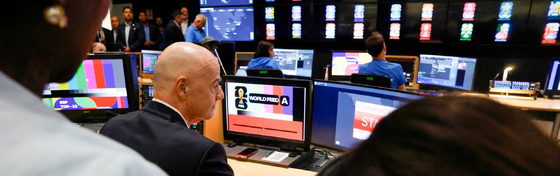
Which brings us to the actual reason this happens at the IBC in Dallas and not in the cloud. Lenovo provides powerful ThinkSystem servers there and deliberately runs the processing as on-premise edge computing, meaning locally at the site of the action, because pure cloud solutions wouldn't have met broadcast latency requirements. The camera's signal is transmitted in 1080i over the private 5G network, run through the AI stabilization at the IBC, and then made available to the host production as a separate, broadcast-ready stream. Fittingly, the World Cup's very first goal, Julian Quinones' strike in hosts Mexico's 2-0 win over South Africa, was captured via this stabilized referee perspective.
The AI stage was already trialed at the 2025 Club World Cup and the FIFA Intercontinental Cup, with FIFA and Lenovo unveiling the new generation in early 2026 at Lenovo Tech World around CES in Las Vegas. To put the scale in perspective: for the entire World Cup infrastructure, Lenovo is deploying more than 17,000 devices and over 200 engineers across the host cities and training facilities, pushing IPTV latency below five seconds. RefCam stabilization is thus just one small, visible piece of a very large technical build.
For all the enthusiasm about the technology, one clarification matters especially for our discussions here: according to FIFA production chief Oscar Sanchez, the RefCam is explicitly not a host broadcast camera in the traditional sense. It was developed by FIFA's Football Technology and Innovation team together with the refereeing department, and then made available for the host feed. It operates under its own guidelines and is not part of the ISO feeds provided to media partners. One of HBS's tasks will be ensuring that production teams across the USA, Canada, and Mexico use the camera in a reasonably consistent, non-inflationary way, so the effect doesn't wear thin.
Not Just Football: RefCam Conquers Other Sports
The concept is catching on elsewhere. The European Handball Federation deployed Riedel's head-mounted RefCam along with the Easy5G system during the final weekend of the Men's EHF EURO 2026, marking the first live broadcast use of the Riedel system outside football. In basketball, the Euroleague used chest-mounted cameras from provider Mindfly during select derbies in the 2023/24 season. And at the World Snooker Championship final in May in Sheffield, referee Rob Spencer wore a tiny lapel-mounted camera, its signal transmitted wirelessly to the OB van and converted there into a broadcast-ready signal, a system from the company Camera Innovations.
What stands out here is the sheer range of technical approaches: head-, chest-, and lapel-mounted, sometimes via radio link to the OB van, sometimes via centralized AI processing at the IBC. We're watching, in real time, an entire device category branch out and diversify.
Why This Matters to Us
RefCam is more than a World Cup gimmick, and it's relevant to our everyday work for three reasons.
First, stabilization. Anyone who has ever edited footage from a helmet-, body-, or action-mounted camera knows the basic problem: the perspective is unique, but the shake makes it unusable for longer shots. If real-time AI stabilization at broadcast quality now works at the biggest live event in the world, it's a safe bet this technology will find its way into our everyday productions over the next few years, from sports features to ride-along reporting to body-cam footage.
Second, the perspective itself. HBS senior producer Paul King puts it nicely: most new technology delivers only incremental improvements, whereas RefCam delivers something immediate. Watch a free kick from this vantage point, and suddenly everyone says "wow," because they're seeing something they've genuinely never seen before. That "something that hits you right between the eyes" has become rare in today's tightly choreographed elite football.
Third, the audio, an aspect that's often overlooked. King explicitly recommends watching the clips with sound on, because it's the audio that really shows how difficult the job is and how fast referees have to communicate. A good reminder for us: a new perspective is always a new audio source too, with all the storytelling and legal questions that raises.
Outlook
Restrictions still remain, particularly around live pictures and live audio. National leagues are hoping these restrictions will loosen after the World Cup, once FIFA's deployment demonstrates that the concept works. It's entirely possible that within two or three years, we'll no longer regard RefCam as a sensation, but as a standard part of any major football production.
For now: next time there's a contentious penalty call, it's worth glancing at the referee perspective overlay. What appears so casually on screen is the result of seven years of development work, a rule change at the highest level, and an AI in Dallas computing the shake out of the picture. Rarely does this much broadcast history fit into fourteen grams.