World Cup 2026: A Look Inside the Engine Room of the Biggest Host Broadcast Operation of All Time
-
Arni -
June 10, 2026 at 12:25 AM -
775 Views -
0 Comments
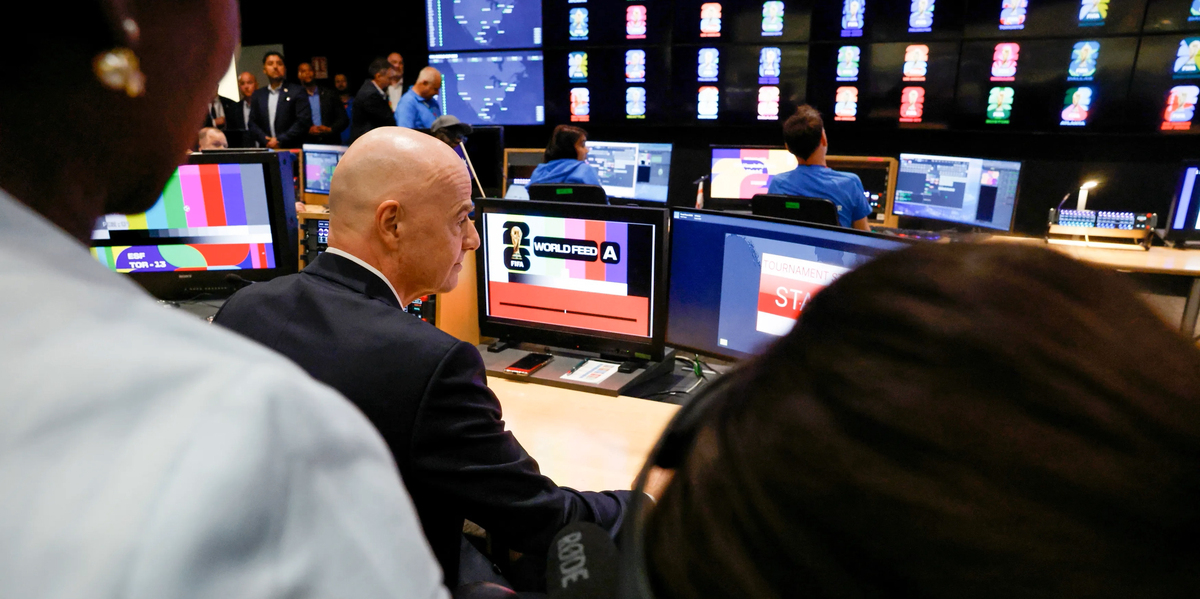
The IBC in Dallas: A 45,000-Square-Meter Control Center
Serving as the International Broadcast Centre is the Kay Bailey Hutchison Convention Center in Dallas, chosen for its central location within the three-country tournament footprint. The facility spans 45,000 square meters and houses host broadcaster HBS, all of FIFA's media partners, FIFA's video production department, the Football Technology and Innovation division, and the VAR room. For scale: that's a good six football pitches' worth of space, packed with control rooms, edit suites, and server rooms. The complex opened on June 1, leaving a tight lead time of just a week and a half before kickoff.
That VAR operates centrally out of Dallas rather than from the stadiums themselves is something we already know in principle from Qatar. What's new is the scale: the distance between Dallas and the northernmost host city, Vancouver, is roughly 2,900 kilometers, and to Mexico City it's 1,500. Every referee decision now travels via fiber optic cable clear across the continent.
The Real Paradigm Shift: 16 Production Teams
Now for the most interesting part for anyone in the broadcast business themselves. For the first time, FIFA is working with 16 independent production teams, one per host city. FIFA production chief Oscar Sanchez explains the reasoning bluntly: "The main difference is that we need more crews, because we have to minimize the risk of people traveling through countries as large as the USA, Canada, or Mexico." The staffing model and production approach were developed jointly with HBS over the past four to five years.
This marks a departure from the classic World Cup model, in which production teams rotated with the matches across the country. At a World Cup in Qatar, with twelve stadiums within a 50-kilometer radius, rotation was trivial. At a tournament stretching from Vancouver to Mexico City, it becomes a logistical nightmare: travel times, jet lag, hotel chains, visa questions spanning three countries. The solution, then: more staff, less movement. The decision to field 16 teams, the most in World Cup history, also means more people, more perspectives, and more languages are shaping the storytelling of this World Cup than ever before.
The Camera Plan: 45 Cameras per Match
All 104 matches receive premium coverage with 45 cameras per match, including pole cams, cable cams, and ref cams, plus cine-style cameras, 360-degree systems, and digital-first devices. For comparison: Russia 2018 had 37 cameras plus specialty systems. The direction is clear: more specialty angles, a more cinematic look, more material for platforms beyond the linear main feed. With an average reach of 300 million viewers per match, rising to as much as a billion during the knockout rounds, FIFA isn't willing to settle for a weak camera position anywhere.
What's interesting to us is the term "digital-first devices" appearing in the official camera plan. If smartphone-class cameras are now showing up in the premium coverage of a World Cup, that's further proof of something we've discussed here in the forum more than once: the line between professional equipment and consumer technology no longer runs along device category, but along purpose of use.
The Quiet Revolution: Centralized Image Technology Across 2,900 Kilometers
And now for the part where our OB-van colleagues should really pay attention. Graphics, replay, and shading are fully centralized, with a handful of replay operators on site as backup in case of connectivity loss. HBS senior producer Paul King breaks it down: "With 16 teams, you'd need 16 replay crews of ten or eleven operators each. That's a lot of people. A centralized facility lets us bring the best in the world together under one roof, all working across multiple matches."
Read that sentence about shading twice. The image technology isn't sitting in an OB van at the stadium, it's in Dallas, driving the cameras across distances of thousands of kilometers in some cases. We know remote shading from smaller productions, but at a live event of this magnitude, with a billion viewers watching the final, this is a statement. If it works, and the trial runs at the 2025 Club World Cup suggest it will, no station controller anywhere in the world will be able to get away with "that won't work for us" much longer. The conversation around remote image technology in national productions is likely to sound different after this summer.
AI in the Host Feed: Avatars and De-Shaken Ref Cams
Two AI innovations are making it into the host feed this time. First, AI-generated 3D player avatars: every player is digitally scanned on arrival, a process that takes about one second per player, producing precise 3D models with exact body measurements. These models feed into the host broadcast and make the VAR system's offside decisions more realistic and easier to follow. Second, the stabilized referee perspective: building on a successful trial at the 2025 Club World Cup, AI stabilization software smooths the ref cam footage in real time and reduces motion blur.
The ref cam stabilization is the point with the most practical relevance beyond the World Cup itself. Anyone who has ever edited footage from a helmet-mounted or body-worn camera knows the basic problem: the perspective is gold, but the shake makes it unusable for longer shots. If real-time stabilization at broadcast quality now works at the biggest live event in the world, it's a safe bet this technology will find its way into our world too, from sports features to police ride-along footage shot on body cams.
The German Workflow: Control from Ismaning, Studio in New York
It's also worth a behind-the-scenes look on the German side. Deutsche Telekom holds the full rights, as we know, with MagentaTV broadcasting all 104 matches, 44 of them exclusively, while ARD and ZDF air 60 matches under sublicense, including all of the German national team's games. Behind that sits a layered partner network that a press release alone rarely captures cleanly, so here's the full chain: Telekom's general contractor is Thinxpool TV, holding overall editorial and production responsibility. DMC Production Germany, formerly Plazamedia, delivers the internal production infrastructure at both locations on Thinxpool's behalf, meaning set construction, LED walls, analysis graphics, playout, and file management in Ismaning and New York.
And now for the part that concerns us as a profession the most, and the part easily missed in the glossy press releases: the actual transmission and remote technology comes from TV Skyline. Their job is the transmission and broadcast technology for the New York studio, within a remote setup spanning New York, the stadiums across North America, the German national team's camp in Winston-Salem, and the broadcast center in Germany. For this, TV Skyline's Ü12 UHD OB van sits at the studio in Ismaning and handles the complete signal management for the remote production. The entire production chain runs fully in HDR for the first time.
Let that sink in: an OB van in Ismaning, near Munich, is the pivot point for World Cup coverage of matches spread across three North American countries. The presentation studio sits at One World Trade Center in New York, while control happens out of Bavaria. What would have been considered a risky experiment just a few years ago is standard practice in 2026. And it's exactly the same remote logic we discussed above regarding the host broadcaster, just this time in German hands. The math on travel costs and staffing has won out here too.
Worth noting on the side: Fox Sports made a last-minute change to its workflow and is no longer streaming in native 4K; the source signal is now 1080p HDR, upscaled to 4K, with no reason given by Fox. So the old industry wisdom holds true even at the biggest production in the world: 1080p with clean HDR often beats native 4K in practical terms, whatever the marketing department likes to claim.
The Dark Side: Who Actually Gets In?
For all the enthusiasm about the technology, an honest accounting has to include this part too. The International Sports Press Association (AIPS) sent a formal letter of protest to FIFA on June 5: many accredited journalists from several African countries were denied US visas, while others received only single-entry visas, making it impossible to follow teams across all three host countries. What that means in practice is illustrated by Ivory Coast's match schedule: Philadelphia, Toronto, Philadelphia. With a single-entry visa, you're locked out after the Canada match. FIFA has confirmed receipt of the letter and points out that entry matters are ultimately consular and immigration issues.
For us as a profession, this is more than a footnote. The finest 45-camera production means little if some of the colleagues meant to accompany, document, and contextualize it are turned away at the consulate. A World Cup that the world can't travel to remains, on the production side too, a contradiction in terms.
What Sticks With Us
Three takeaways worth remembering. First, the 16-team model and the centralized image technology out of Dallas amount to a large-scale trial for the future of our OB-van world, and its results will shape the remote conversation here too. Second, the official camera plan, with cine-style, 360-degree, and digital-first devices alongside classic system cameras, confirms the trend toward a mixed fleet that we already know from our own daily work. And third, the most exciting technical innovations of this World Cup, remote shading across continental distances and real-time stabilization, are exactly the ones that will arrive in our everyday productions within the next two or three years.
With that in mind: keep your eyes open while watching. Not just on the ball, but on the edges of the frame, the perspective shifts, and the ref cam cutaways. Right now, the biggest live laboratory our industry has ever seen is running in real time.